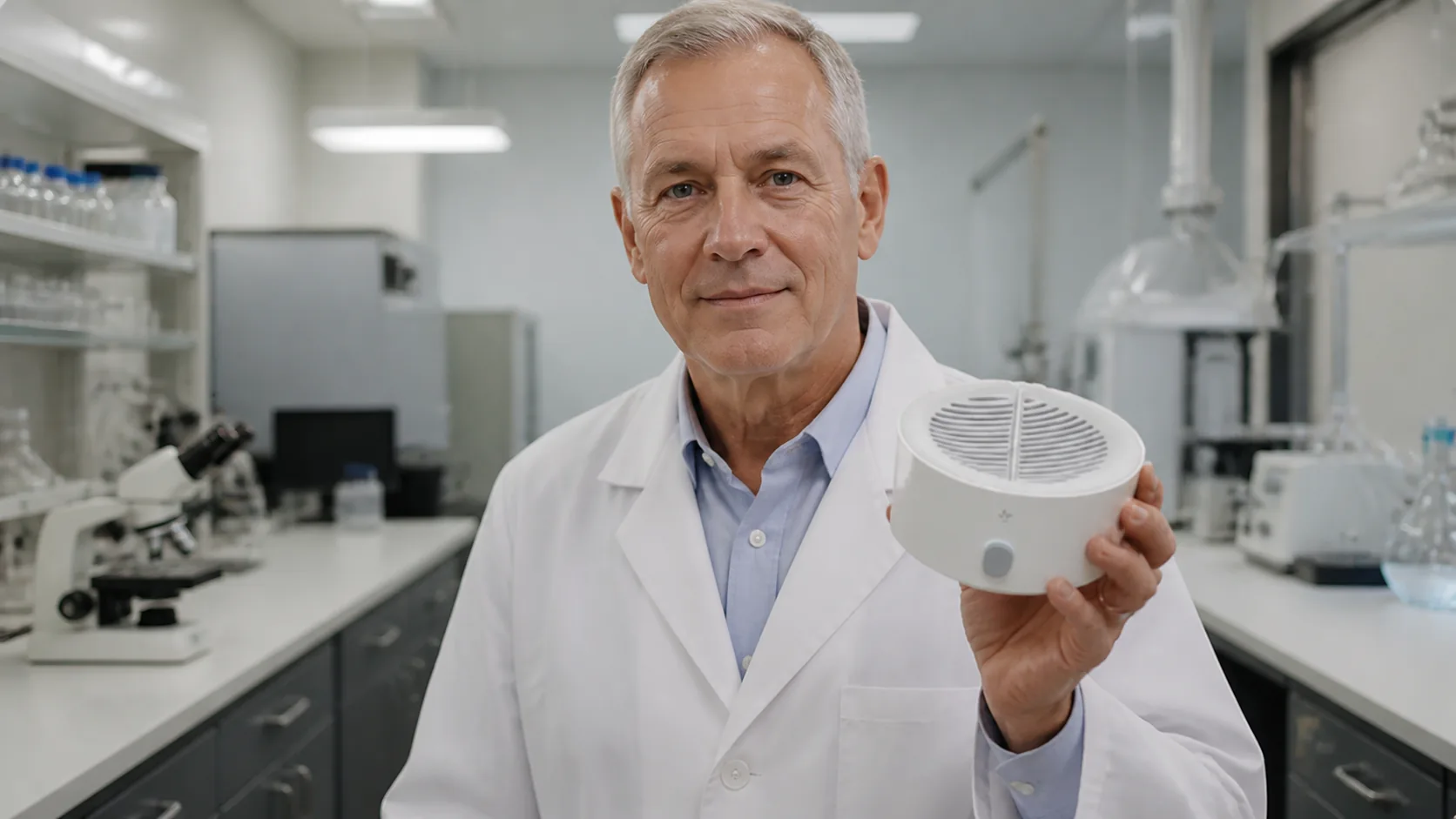
A Lab Researcher Spent 18 Years Testing Pesticides on What You Eat. What He Found Was Never Supposed to Go Public.
His 3-minute trick is the first real way to get the chemicals off your family’s food.
By Sarah Mitchell, Health Editor|June 10, 2026|
459,923 people seen this
For 18 years, Marcus Bowen worked inside the food safety labs.
He was the one running the tests. Recording what was on the food. Filing the reports.
Strawberries. Apples. Grapes. Spinach. Peppers. The produce families buy without thinking twice.
And what he saw — every day, for 18 years — was a system that was never designed to protect you.
Produce covered in chemicals that kept passing inspection. Reports that always came back the same way. A testing process that looked thorough on paper — and missed almost everything that mattered.
"You tell yourself you're part of the system that keeps food safe," Marcus said.
"That's what they tell you when you come in. But after a while, you realize you're not keeping food safe … you're keeping the system comfortable."
He knew all of that. And stayed quiet.
"I filed those reports for years," he said.
"Then I went home and fed the same produce to my own family."
That was the part he couldn't live with anymore.
So he started digging into what the industry didn't want anyone to see. And what he found was worse than anything he'd tested in the lab.
HE SAW SOMETHING HE WAS NEVER SUPPOSED TO SHOW ANYONE.
The first thing Marcus did was pull two datasets.
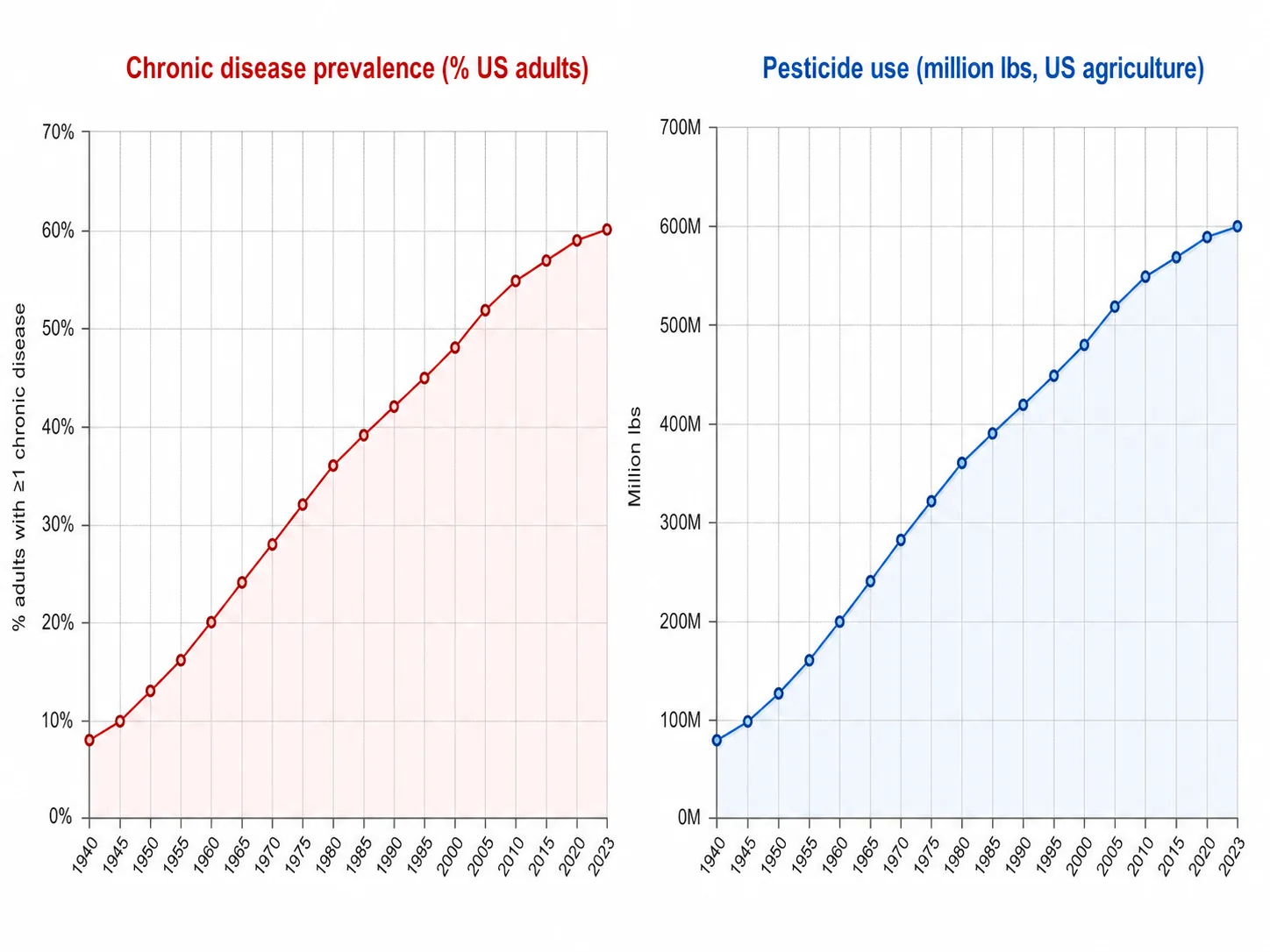
One tracked pesticide use in American agriculture going back to 1940. The other tracked chronic disease rates among American adults over the same period.
He put them side by side.
“I stared at those two lines for a long time,” he said.
“Then I showed a colleague. Neither of us said a word.”
Look at the chart below. Look at the two lines. And pay attention to how they move.
8% of American adults had a chronic disease in 1940.
Today it’s 60%. Six out of ten.
The two lines move together. Decade after decade. Without a single break.
“You can’t look at those two curves and tell me the food had nothing to do with it,” Marcus said.
“Something changed in the 1940s. The body hasn’t adapted. And the diseases have not slowed down in a single one of those years.”
He sat with that chart for a long time. Then he thought about his kids. His wife. Every meal he’d put on the table after a full day of testing the same food in the lab.
If the food carries all of this — what is a rinse under the tap actually doing?
THE WASHING WAS NEVER GOING TO SAVE YOU.
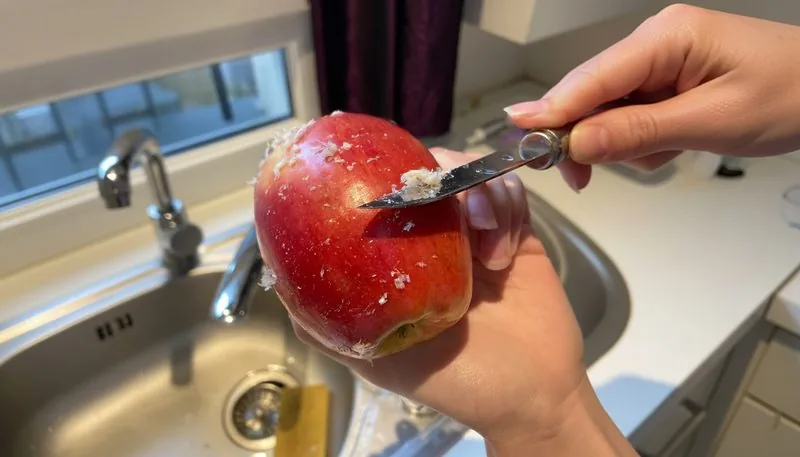
On most common fruits and vegetables — apples, cucumbers, peppers, tomatoes — a synthetic industrial wax is applied to the skin after the produce has already been treated with pesticides.
When you rinse an apple under the tap, you’re washing the outside of a seal. Everything underneath stays exactly where it is.
The wax makes it look shinier. Extends the shelf life. And seals the pesticide residues directly against the surface.
And “pre-washed”? That label means the visible dirt was removed. The pesticides, the bacteria, the insects that survive water entirely — still there.
“The washing is theater,” Marcus said.
“I ran residue tests for a living. I can tell you what’s still on that produce after you rinse it. Everything.”
BUYING ORGANIC WON’T PROTECT YOU EITHER.
And if you think buying organic keeps your family safe — consider this.
The United States currently allows 85 pesticides on your food that have been banned in Germany, China, and Brazil.
Three of the largest countries on earth said — too dangerous. Those chemicals are still on American produce today.
And organic doesn’t escape it. Residues still show up in organic produce. Cross-contamination from neighboring farms. Contaminated water. And chemicals banned over a decade ago are still sitting in the soil that organic farms grow your food in.
“Organic doesn’t mean ‘clean.’ The system is contaminated at every level.” Marcus said.
“I was close to accepting that there was nothing a family could actually do,”
Then he looked at the problem differently.
THE ANSWER WAS IN FRONT OF HIM FOR 18 YEARS.
Marcus had spent 18 years working around electrolytic technology. Labs use it. Hospitals use it to disinfect surgical instruments. It breaks molecular bonds safely, without chemicals.
He’d never thought about applying it to food. Nobody had.
But the more he looked at the problem — the wax, the chemical bond, the residues absorbed into the cells — the more he realized that produce didn’t need a better wash.
It needed something that could break the bond at the molecular level.
He brought the idea to a team of engineers who had spent years developing electrolytic cleaning systems for hospital and pharmaceutical use.
It took them fourteen months to build a version that worked in a kitchen bowl.
They called it KitchenPura.
KitchenPura · How It Works
Three steps. Three minutes. No chemicals.
1
Add water and a pinch of salt.
2
Drop in your produce.
3
Press one button and walk away.
“I already knew what was in that water,” he said.
“I’d spent my career measuring it. And this was the first time I’d ever seen anything actually pull it off.”
✓ No chemicals, no aftertaste — just water, salt, and electricity
✓ Hands-free in three minutes — one button
✓ USB rechargeable, fully waterproof, fits in a kitchen drawer
Two Independent Tests. The Results Were Hard To Ignore.
Marcus didn’t take anyone’s word for it. He tested KitchenPura the way he’d tested everything in the lab — by looking at what actually came off.
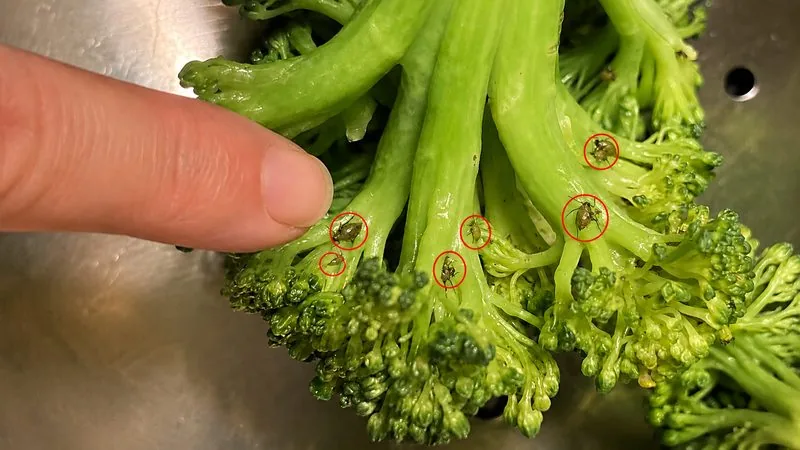
Test 1 — Broccoli that had already been washed.
He rinsed broccoli under cold running water the way most families do. Then ran it through a KitchenPura cycle.
What came off in the first 90 seconds — on produce most families would consider clean:
Real Results · Independent Testing
What KitchenPura pulled out of one bowl of broccoli:
⚠Pesticide residue — multiple compounds, undetected after rinsing alone
⚠Surface bacteria — from soil, handling, and packing facilities
⚠Wax coating deposits — the synthetic layer sealing everything against the skin
⚠Live aphids — visible in the water within 90 seconds. Completely undetected after a standard rinse.
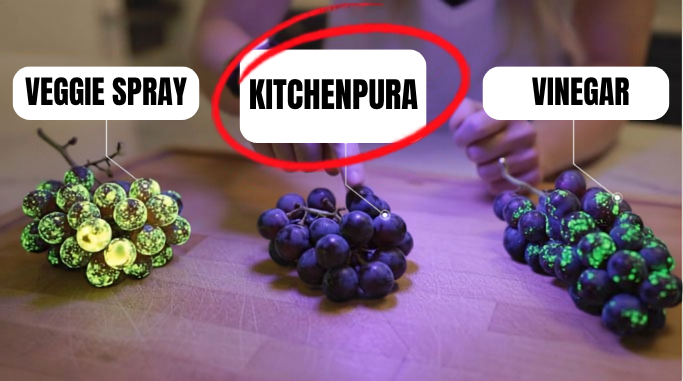
Test 2 — UV blacklight comparison.
Three bunches of grapes. Each cleaned with a different method. Then examined under UV blacklight — the same tool Marcus used in the lab for years. Under the light, pesticide residue glows bright green.
The Emails That Land in Marcus’s Inbox Every Morning.
Marcus isn’t the only one who had that reaction.
Since KitchenPura launched, families across the country have been sending in messages describing the same moment — the moment they saw what was really on their “clean” produce.
✉ Email received · June 29, 2026
“My husband is a toxicologist — he studies pesticide exposure for a living. I ran KitchenPura on broccoli we’d already washed and showed him the water. He asked me to run it again on the strawberries. Same result. He said he’d never seen a consumer device actually do that before. We haven’t rinsed produce without it since.”
— Diane C. · Columbus, OH
✉ Email received · June 14, 2026
“I almost didn’t try this. I’ve bought too many things that promised to do something and did nothing. But I put in the broccoli I’d already washed for dinner. The water turned grey-brown in under two minutes. I called my husband in and made him look. He said: ‘That came off the broccoli?’ We stood there for a while. I’ve used it every single day since.”
— Michelle R. · Nashville, TN
“These are people who were already doing everything right,” Marcus said.
“Washing carefully. Buying organic. Reading labels. And the water still showed them what they were missing. That’s not a gimmick. That’s 18 years of residue testing telling you the same thing I’ve been trying to say.”
You Won’t Find This on Amazon. And Marcus Says That’s the Point.
KitchenPura is not on Amazon. Not at Walmart. Not at any retail chain.
It’s sold exclusively through the official website. And after 18 years of watching the system prioritize profit over safety, Marcus says that’s exactly how it should be.
“The moment you hand something like this to a marketplace, you lose control,” he said.
“You get counterfeits. You get knockoffs that look the same in the listing photo but don’t replicate the electrolytic method. They don’t work — and families think the whole concept is a scam. I’ve seen too many good things get buried that way.”
⚠ Important Warning
Counterfeit KitchenPura devices have already started appearing on Amazon and other marketplaces. They look similar in photos but use inferior components that do not replicate the method. The only genuine KitchenPura is available at the official website.
Only 800 Units Remain. And There May Not Be More for Months.
Three months ago, the supplier of the titanium electrolysis components Marcus specified in his original design suspended operations. His team has been sourcing alternatives — but hasn’t found one that meets his specifications. He won’t release a device built to a lower standard.
The 800 units currently available are the last ones built the right way. When they’re gone, the next production run is genuinely uncertain.
⚠ INVENTORY UPDATE · AUGUST
Nearly half of the remaining 800 units have already shipped out this week.
“Demand has been significantly higher than we anticipated. Once this inventory is gone, we genuinely don’t know when — or if — we’ll have more. It could be months. If you’ve been thinking about it, please don’t wait.”
18 Years Inside the System. Now He’s Telling Every Family the Same Thing.
The water will show you everything your rinse was always leaving behind.
And once you’ve seen it — in your own bowl, on produce you thought was clean — you don’t go back.
But the water isn’t the only thing that changes. Families who use KitchenPura consistently say their produce lasts up to five times longer in the fridge. And the taste is different. Cleaner. Fresher. Like produce is supposed to taste when there’s nothing coating it.
If you’ve tried veggie sprays or vinegar before and seen no difference — that’s not a coincidence. They aren’t designed to break pesticide bonds. KitchenPura does something fundamentally different. That’s why the water looks the way it does.
KitchenPura comes with a 30-day money-back guarantee. If the water doesn’t convince you, every dollar comes back. No questions asked.
“I spent 18 years inside a system that was never built to protect your family,” Marcus said.
“I can’t go back and change what I saw. But I can make sure every family has a way to see it for themselves — in their own kitchen, in three minutes, with their own eyes.”
This isn’t about trusting a product. It’s about trusting what you see.
“I’m a retired nurse. Thirty years of being careful about what I put in my body. I thought I had produce figured out. Three minutes with KitchenPura showed me I didn’t. I’ve recommended it to everyone.”
✓ Amanda S. · Denver, CO
★★★★★
“My kids now ask if we did ‘the water thing’ before eating fruit. They’re 7 and 9 and they genuinely get it. That’s how I know it became part of our life.”
✓ Tom K. · Austin, TX
★★★★★
“I’ve been buying organic for fifteen years and felt smug about it. The first cycle humbled me. I texted my sister immediately. She ordered one that same night.”
✓ Rachel M. · Chicago, IL
★★★★★
“I showed my mom the water after the first cycle. She’s 68 and has been washing produce her entire life. She went completely quiet, then said ‘I need one of those.’ I ordered her one before we even finished talking.”